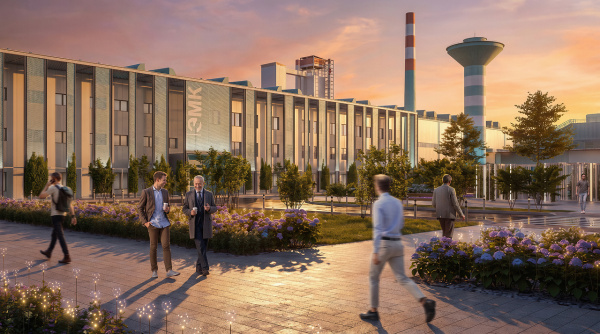
After the Post-Industrial City

The post-industrial city has been the mainstay of urban planning over the recent decades, with the removal of industrial facilities from cities as one of its key characteristics. Today, the opposite trend is taking shape: enterprises are returning to cities.

Meanwhile, enterprises have changed. Environmental sustainability and innovation are becoming their main strengths, the criteria that influence business success. Competition for human capital is growing—professional engineers and operators of complex systems are becoming more selective when choosing where to work. Businesses need to figure out how to attract people to their enterprises. Neo-industrial cities are forming on this basis.

The industrial monotown of Vyksa, with a population of fewer than 50,000 people, is developing simultaneously as a cultural and industrial centre. The driving force behind this process is United Metallurgical Company (OMK). In the early 2010s, with their corporate support, we curated the Art Ovrag (“Art Ravine”) festival of contemporary culture, which was reinvented as the Vyksa Festival starting from 2021. Next, we developed the concept for the Shukhov Park industrial tourism centre on the site of a former cast iron factory.

In parallel, we designed the facades of new workshops and public spaces for the industrial site of Vyksa Steel Works (VMZ), OMK’s main enterprise. The ultra-modern production facility has been moved outside the city centre and is constantly growing and modernising, while a creative and educational cluster is taking shape on its former site with corporate support. Vyksa may well become Russia’s first neo-industrial city.

We see industrial enterprises remaining in cities and investing in their production facilities. For Sibur Holding, Wowhaus has designed a new business district next to the Kazanorgsintez industrial site outside Ufa, with a research and development centre and conference hall.

Neo-industrial cities are defined by reindustrialisation and a different approach to organising production facilities and industrial sites, impacted by new standards of urban renewal and landscaping as well as the need to attract and retain employees. Here, as in other projects, we put people first while creating interactive, distinctive designs.

Oleg Shapiro: “It is easiest to develop new production facilities on the basis of those vast industrial territories that already exist across the country. Tomorrow’s reality will feature industrial parks with a variety of additional functions not directly linked to production.”